
[Draft 4-12-2026]
Moral inferences & influencers
The other day at my gym, I got into a conversation about a media influencer who talked about how some contemporary despots did really bad things, but also improved the lot of others. Or how famous, honored activists (or celebrities) did some really good things, but kept secret some really bad things. Is such moral duplicity anything new under the sun? Like the “pitchfork effect.” Or “halo effect” (especially for priests).
The implication was some sort of tally of debits & credits. So that moral worthiness depends on a good enough moral “batting” average. Or that there’s adequate majority merit, like 51% good and 49% evil.
This struck me as “moral accounting,” which historically the Church rejected. Such accounting encouraged some to literally try to buy their way into heaven (indulgences) – much like compensatory carbon credits. Or, even trade or transfer (loan) merit (to get around that “eye of a needle” thing). And perpetuated the notion that great wealth is a sign of social superiority and spiritual merit.
In my notes below [1], I cite an overview of this issue. A perceived moral merit system of credits & debts against a prescribed list of dos and don’ts encourages hypocrisy. Hedging. False piety.
The shadow of that Medieval moral structure persists. Replete with pride or despair. Even the practice of keeping “moral ledgers.” Penance, charity, and good works create credits. Bad deeds are balanced through confession, acts of contrition, and financial donations – transactional merit.
Reformed (reframed) doctrine pivoted from a structure of “earning” merit to the agency of faith and gift of grace. Often this is deemed as change of heart or being reborn – leaving behind a transactional (performative) moral legalism and “shifting the focus from ‘buying’ heaven to grateful service for a gift already received.”
Yet, I’m not confident that this shift, for example, granted Puritans true peace of mind – overcame their incessant anxiety over sanctification (which I’ve written about elsewhere, including their belief in magic). Justification “by faith alone” is catchy but cringey.
The use of guilt to compel belief keeps the “fairy tale” of moral accounting alive. Moral bullying. Temperamental tendencies. And the framework of “situational ethics” remains a slippery slope in practice.
But I’ve grown more & more to appreciate the gifts of grace from others, gifts which I did not earn. I enjoy media stories of how people respond to acts of grace. Whether they get a new groove, “participate in a ‘new reality’ that makes right action possible.”
Living in a merit-based economy but without a merit-based view of salvation

… many evangelicals have compartmentalized God’s grace so that it’s only about heaven. God’s grace gets me into heaven, but everything else I have to earn, which means that everything else I can take complete credit for. – United Methodist Insight > Why Moralistic Meritocracy Is Incompatible with Christian Teaching by Morgan Guyton (8-28-2015)
I think that a relational framework holds promise for a more authentic doctrine of morality (and in other fields besides theology).
Rejecting accounting allows righteousness to be about solidarity with others rather than personal honor or “proving worth”.
For this to happen, however, our moral circles [4] need to grow & expand. Beyond the notion of a pilgrimage of solitary souls, beyond even the notion of tribes or communities, to that of global interdependency. A relational faith, a wider sense of responsibility, connectedness.

Luna City

Regarding “moral accounting” as the process for assessing the soul’s worthiness …
Heinlein’s 1966 novel The Moon Is a Harsh Mistress portrays a society where compelling interdependency shapes its citizens behavior. Antisocial souls are culled pragmatically, thereby inducing voluntary cooperation & shared effort. Luna City life links personal responsibility and subsequent social practice. But does such a framework scale well?
Because the Moon is a harsh, enclosed environment, survival dictates strict individual responsibility. The community is against antisocial, impolite behavior, leading to a culture of courtesy. – AI Overview – the moral framework for luna city in heinlein’s 1966 novel the moon is a harsh mistress
One first thing learned about Luna, back with first shiploads of convicts, was that zero pressure was place for good manners. Bad-tempered straw boss didn’t last many shifts; had an “accident”—and top bosses learned not to pry into accidents or they met accidents, too. Attrition ran 70 percent in early years – but those who lived were nice people. Not tame, not soft, Luna is not for them. But well-behaved. – Heinlein, Robert A. The Moon Is a Harsh Mistress. Kindle Edition (2018).
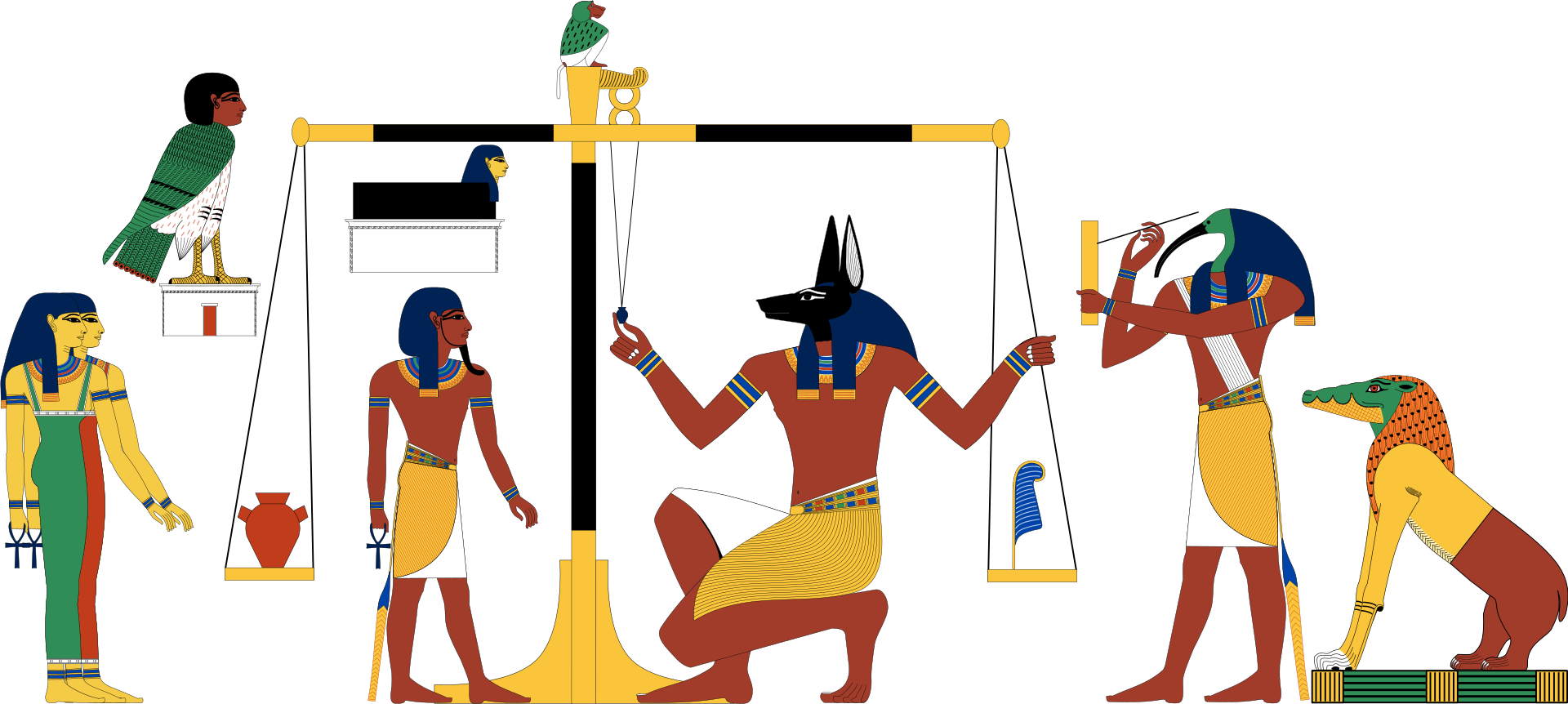
Scales of Osiris [2][3]

There’s an arc in my story – featherweight soul (working title) – which might play out in the future – an arc about the algorithm. Perhaps the “scales” which Osiris uses to judge the deceased are flawed, in both the deity-departed (performative, rhetorical) interrogation and (calculative) weighing device. There’s an algorithm in both cases: (1) a lie detector, and (2) an assay of amalgamated (synthesized, fused) moral mass (‘weight’, inertia).
Is Maat’s feather algorithmic? If so, what is it? Does an algorithm make sense?
Notes
[1] The overview was created by doing this Google search:
Church history of the notion of “moral accounting” and salvation
[2] the nature of the heart in ancient Egyptian mythology
AI Overview
In Ancient Egyptian mythology, the heart (ib) was considered the seat of intelligence, memory, emotion, and the soul’s moral worth, rather than the brain. Left in the body during mummification, it was considered crucial for the afterlife and was weighed against the feather of Ma’at (truth) to determine worthiness to enter the paradise of the Field of Reeds. [1, 2, 3, 4]
Key Aspects of the Heart in Egyptian Belief
- Source of Self: The heart was seen as the physical “motor” and the spiritual core of a person’s being, recording all good and bad deeds performed in life.
- The Weighing Ceremony: In the Hall of Truth, the jackal-headed god Anubis would weigh the deceased’s heart on a scale against the feather of Ma’at (goddess of truth/justice).
- Judgment Result: If the heart was balanced, it signified a life of integrity, and the soul was deemed worthy. If “heavy” with sin, the heart was devoured by the goddess Ammit (a creature with the head of a crocodile, forelegs of a lion, and hindquarters of a hippopotamus), causing the soul to be destroyed or face a “second death” (total oblivion).
- Heart Scarabs: Amulets, often scarab-shaped, were placed on the mummy’s chest to protect the heart and prevent it from “creating opposition” or revealing secrets during the judgment.
- Terminology: While the physical heart was sometimes referred to as haty, the spiritual heart/soul was known as ib, notes the Egypt Museum. [1, 2, 3, 4, 5, 6, 7, 8, 9, 10]
Mummification and Protection
Unlike other organs stored in canopic jars, the heart was intentionally left inside the mummy because it was considered essential to one’s identity for the afterlife, says the McClung Museum. Prayers, such as those in Spell 30 of the Book of the Dead, were often inscribed on heart scarabs to ask the heart not to bear witness against them, as described by PMC. [1, 2, 3, 4]
[3] AI Overview – modern lie detection technology
Yes, modern lie detection technology, particularly computerized polygraphs and AI-based systems, uses algorithms to analyze data. These systems apply algorithms to interpret complex physiological stress signals or biometric cues—like eye movement and heart rate—to categorize responses as truthful or deceptive, often achieving higher accuracy than human intuition.
The Policing Project +2
How Algorithms are Used in Lie Detection
- Computerized Polygraphs: Modern polygraphs record physiological responses (heart rate, respiration, skin conductivity) and use software to analyze these recordings. While an examiner still plays a major role in interpreting results, the software helps quantify these involuntary physiological changes.
- AI and Machine Learning: Newer tools, such as EyeDetect, utilize cameras to track pupil dilation, eye movement, and response times, using a Proprietary algorithm to calculate a “cognitive load” score indicative of deception.
- Data Analysis: Researchers develop machine learning algorithms to identify patterns in body language, such as blinking rate, speech patterns, and facial movements. These algorithms are trained on data from truthful and deceptive statements to establish a classification model, often identifying signs of stress that humans miss.
American Psychological Association (APA)? +5
Limitations
- While algorithms can increase accuracy, they are not infallible. They rely on the assumption that a particular physiological response (like increased heart rate) equals lying, rather than just fear or stress.
- AI models have achieved accuracies around 75% to 79%, which is better than chance but not perfect.
University of California, Berkeley? +4

[4] A relational framework – a complex web of relationships – need not be a zero-sum primal landscape. Embracing a wider sense of kinship may expand our circle of moral concern.
• NPR > “Expanding The Circle Of Moral Concern” by Tania Lombrozo (November 15, 2016) (February 2, 2026) – Moral progress is an easy idea to embrace, but it’s not an easy idea to defend. What, after all, is the force that ensures we move in the right direction?
AI Summary
The idea of an expanding circle of moral concern, where our ethical considerations grow to include larger groups and even nonhuman animals, is widely accepted. However, moral progress is not guaranteed and requires active effort to treat others well and make ethical decisions. The author expresses a personal commitment to expanding their circle of moral concern to include various marginalized groups.
Quotes
In an influential book of ethics first published in 1981, the philosopher Peter Singer offers a striking image of moral progress over the course of human history: an expanding circle of moral concern, beginning with our own family or tribe, and expanding over time to include larger groups, nations, families of nations, all humans and perhaps even nonhuman animals.
With our evolved cognitive capacities and the help of increasingly sophisticated reasoning, we can come to appreciate how and why the scope of our moral concern should grow.

Are fables alive and well? Do they still grab our attention? Has the moral landscape changed since the time of ancient Egyptians? Since the time of Aesop? Is Aesop’s voice still recognized by new generations? Or do they taste his tales twined in animated films like Zootopia.
My attempts at writing 21st century fables were inspired by Aesop’s work. My latest guide is the collection The Complete Fables AESOP. Robert Temple’s introduction is a fascinating historical overview – the “reality” of Aesop and the trek to what we read today under that rubric.
In particular, Temple framed the moral landscape of 2500 years ago as a “combination of humour and barbarism” as yet untouched by the “ethical transformation of Western culture which came about as a result of Christianity.” While “brutality, violence and corruption” persist, there’s a public consensus regarding norms of “right” action, kindness & caring.
Our digital streams retain savage humour, laughter at the misfortune of others; clever wordplay by politicians and elites, deft wit by late night talk show hosts.
As our ethos realigns over time, does the “weighing of the soul” change? On a spectrum from the “law of the jungle” (“why animal stories were so appropriate”) and mockery of compassion (viciousness as virtue) to … more democratic aspiration & wider social justice.
Might the Assessors of Maat ask:
[Excerpts]
Aesop. The Complete Fables (Penguin Classics 1998) Kindle Edition. Introduction by Robert Temple February 1997.
The fables themselves are far from the sugary children’s stories that many might imagine them to be. Most of those children’s editions of Aesop are carefully selected and so heavily rewritten and artificially expanded that they have only a tenuous connection with Aesop. At least one hundred of the most interesting fables, namely the weirder mythological ones, appear never to have been translated into English at all, so that the fables as a whole have thus been ‘purged’ or ‘whitewashed’ and given a false image until now of a ‘classic’. But perhaps that is the reason: a classic is something which is arrived at by consensus, and the weirder of the Aesop fables might have destroyed that consensus pretty quickly if anybody but a Greek scholar had ever been able to read them. For the fables are not the pretty purveyors of Victorian morals that we have been led to believe. They are instead savage, coarse, brutal, lacking in all mercy or compassion, and lacking also in any political system other than absolute monarchy. With one exception the kings are tyrants, and the women who appear include a young wife who scratches and claws at her (evidently brutal) husband’s face, and one who is really an animal disguised as a human who pounces on a mouse to eat it.
This is largely a world of brutal, heartless men – and of cunning, of wickedness, of murder, of treachery and deceit, of laughter at the misfortune of others, of mockery and contempt. It is also a world of savage humour, of deft wit, of clever wordplay, of one-upmanship, of ‘I told you so!’ So stark is the world of Aesop that it calls to mind two reflections: first, women were relegated to such obscurity and powerlessness that they were unable to influence the actions of men or ameliorate them, and were essentially slaves. (We know from an analysis of surviving legal speeches that in classical Athens a woman who was an heiress could be seized from her husband and children, forcibly divorced and married to a distant male relative whom she didn’t even know simply because she was the legal conduit through which property flowed within her father’s family, and a family property owner must be male.) Second, there seems to have been no general public consensus that compassion towards one’s fellow human beings had anything particularly to recommend it.
– Aesop. The Complete Fables (Penguin Classics) (pp. xvi-xvii).
The latter observation is an important one, for we probably tend to underestimate the ethical transformation of Western culture which came about as a result of Christianity. In the West today there is also much brutality, violence and corruption, but among all of that there is also a widespread public consensus that it is a good thing to be kind to children, to care about the unfortunate, to help one’s neighbour, to assist the elderly across busy streets and to come to the assistance of someone in distress who may be drowning or being murdered in the street. But these attitudes seem to have been absent in ancient Greece except in the case of occasional individuals. The underlying ethos of the world of Aesop is ‘you’re on your own, and if you meet people who are unfortunate, kick them while they are down’. The law of the jungle seemed to prevail in the world of men as well as of animals for Aesop. Perhaps that is why animal stories were so appropriate.
The Aesop fables provide fascinating glimpses of ordinary life in ancient Greece. Details emerge of objects of daily use, such as wigs and dog collars, which are occasionally surprising. Through the fables one gets inside people’s homes, learns what mice liked to eat – and hence what was in the larder – how pets were treated, how sons were spoilt, how superstitious everyone was, how merchants and tradesmen thought and acted, how a farmer could take it into his head to set up as a merchant trader and set out to sea with a small cargo of goods, how frequent disastrous shipwrecks were, how mistreated the donkeys were, how a miser would bury his gold, how a master would buy a new slave, how one staved off mockery by quick repartee. Such insights enable us to have the kind of understanding of ancient Greek life which does not come from reading Plato or Thucydides. Here we are face to face with peasants, tradesmen and ordinary folk, not mixing with the educated classes. Coarse peasant humour is found throughout the Aesop material, and some of the jokes would not be out of place in rough country localities round the globe at the present day.
The fables are essentially a joke collection. They are an ancient joke book in the same sense that Artemidorus’s Oneirokritika (late second century AD) is an ancient dream book. These collections were meant to be thumbed through and consulted for relevant items as occasion demanded. They were reference books of material intended for use.
The combination of humour and barbarism so characteristic of the Aesop fables may have alienated many classical scholars. Certainly there are any number of scholars of a snobbish disposition who would think it beneath them to concern themselves with coarse peasant jokes and the doings of the man-about-the-market-place. Such factors must be involved in the strange lack of attention given to the Aesop fables by classical scholars, and the lack of a previous English translation of the entire corpus.
– Aesop. The Complete Fables (Penguin Classics) (pp. xvii-xviii).
The notion of a merit system which tallies one’s moral worthiness persists in modern drama.
So, how might an algorithm (if an algorithm makes sense) be visualized? As a moral score? – perhaps like a credit score for financial worthiness? A matter of points.
Well, that’s the premise of NBC’s fantasy-comedy TV series The Good Place. There’s 24/7 surveillance of your actions – there’s no privacy, all private data is in the “Cloud.”
New arrivals in the afterlife watch an orientation video which explains how their souls are weighed. A “perfectly accurate measuring system” scores every action and then calculates the “total value” (moral worth) of a person’s life; then “only the people with the very highest scores – the true cream of the crop – get to come here, to the Good Place.”
There’s even an advanced artificial being – Janet – a celestial concierge who assists the residents.
And “Jeff the Doorman, the gatekeeper of the doorway between the afterlife and Earth.”
And “Neil, the manager in the Accounting office where all the life points are calculated.”
And “Gen, the true Judge of the universe, who has near-omnipotent governance over reality and mediates affairs between the Good Place and Bad Place. She … oversees trials of worthiness …”
Is there a moral dynamic to the afterlife? Ethical nudges, second chances, course corrections? Is it really about salvation?
• Wiki > The Good Place (TV series 2016 – 2020)
Notes
[1] Oddly enough, these three films or TV series all were released in 2016: Gods of Egypt, Zootopia, and The Good Place (season 1). I’ve recently cited them as visualizations of the moral landscape.