
AI Summary A (tap to expand or collapse view)
The portrayal of holy battles, both earthly and heavenly, often uses imagery of angels and demons, light and darkness, to depict conflicts between cultures, values, and virtues. This imagery, rooted in biblical and theological origins, has evolved over time, with figures like Archangel Michael symbolizing divine protection and spiritual warfare. However, Pope Leo XIV rejects the use of such imagery to justify war, emphasizing the nonviolent power of Christ’s resurrection and advocating for peace through dialogue and understanding.
AI Summary B (tap to expand or collapse view)
In an era defined by deep polarization, our cultural conversations often default to a comforting but dangerous habit: ethical dualism. We instinctively divide the world into absolute light and absolute dark, turning every disagreement into a cosmic battle.
This thought-provoking essay unpacks that destructive impulse by weaving together threads from modern television, theology, and consumer culture. Using the character of Michael from The Good Place alongside the historical iconography of the Archangel Michael, the piece explores how easily we rely on militant frameworks to make sense of our world. A powerful counterweight is found in the nonviolent stance of Pope Leo XIV, who famously challenged the weaponization of spiritual icons for worldly “Holy Wars.”
Ultimately, the essay shines a critical light on how easily militant metaphors are commoditized—such as slogans like “Prayer is the Battle Plan”—simply because they offer a cheap, visceral sense of purpose in a chaotic world. Concluding with a poignant poetic call to action, the piece challenges us to resist being reduced to mere data snacks and attention fodder, urging us instead to find ways to engage in necessary struggle without demonizing the opposition.
Table of contents (tap to expand or collapse view)
- Intro
- Defender of the faith
- Holy War
- Prayer
- Common good
- Notes
- References
- Related posts
- Storycraft
Epigraph (tap to expand or collapse view)
“Both read the same Bible, and pray to the same God; and each invokes His aid against the other. …” – Abraham Lincoln’s Second Inaugural Address
“… in the churches the pastors preached devotion to flag and country, and invoked the God of Battles beseeching His aid in our good cause in outpourings of fervid eloquence which moved every listener. …” – Mark Twain, “The War Prayer“
“Although prayer is native [natural] to man, there is the danger that he will misuse it. … Never make prayer a substitute for work and intelligence. … [Don’t] make God a cosmic bell hop, a universal errand boy. … Don’t pray for God to help you get even with your enemy. … Don’t pray that your country will win the war. – Sermon: “The Misuse of Prayer” by Martin Luther King, Jr.
Holy battle – on earth and in the heavens – is a familiar way to depict clashes between cultures and countries, divisions between moral values and spiritual virtues. Especially in turbulent times, riled by social grievance and religious offense. The tone may become apocalyptic, imbued with militant metaphors and sacred symbols. Angels / demons, heaven / hell, light / darkness, saved / dammed, pure / corrupt.
I recently viewed the 2016-2020 TV series The Good Place. While the series avoids traditional religious tropes & iconography in exploring ethical behavior, its framework is nevertheless one of moral dualities: good & bad, light & dark, angel & demon, heaven & hell.
For example, although garbed in a tailored suit, the character Michael was based on the archangel Michael.
Ted Danson as Michael, an immortal being who works as the “architect” who runs the afterlife neighborhood … “Michael” is a Hebrew name meaning “who is like God”. The character of Michael was based on the archangel Michael.
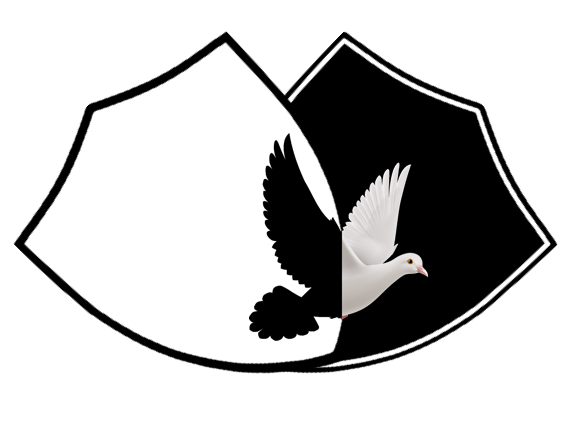
Defender of the faith and patron of warriors
The figure of Michael (archangel) appeared in pre Christian, early Christian, and later Christian eras.
(example)
Epiphanius of Salamis (c.310 – c.320 – 403) in his Coptic-Arabic Hexaemeron additionally referred to Michael as a replacement of Satan. Accordingly, after Satan fell, Michael was appointed to the function Satan served when he was still one of the noble angels.
Even today, images of Michael – as a noble, defender of righteousness – persist. Sometimes as slogans on T-shirts. Is this a message of holy battle (see below).
Here’s some context:
Prompt: Archangel Michael with sword and shield, symbolizing divine protection and spiritual warfare
(AI Overview)
Archangel Michael with a sword and shield symbolizes divine protection and spiritual warfare. Rooted in the Bible (Daniel, Revelation) as leader of heaven’s army, this imagery gained prominence during the Middle Ages, cementing his role as the ultimate defender of the faith and patron of warriors.
Biblical and Theological Origins
The Book of Revelation (12:7-9): Depicts Michael leading the heavenly host in a cosmic battle against a dragon (representing Satan) and his fallen angels. This established him as the archetype of spiritual warfare, defeating cosmic evil and casting it out.
The Book of Daniel (10:13, 12:1): Identifies him as a “great prince” who stands up to protect the people of Israel during times of distress.
Evolution of the Imagery
The Middle Ages: As the warrior culture of Europe integrated into Christianity, Michael’s iconography shifted from a peaceful, winged messenger to a celestial knight in medieval armor wielding a sword and shield. He was heavily revered by crusader and military orders.
Sword and Shield Meaning: In Christian art, the sword represents spiritual combat, the active defense of God’s truth, and the cutting away of negative or dark energies. The shield represents divine grace, faith, and protection against the unseen spiritual battles of life.
Patronage: Due to this militant persona, he is historically and currently venerated as the patron saint of soldiers, police officers, and those seeking spiritual fortitude.
Modern Application and Universal Significance
Liturgical Protection: Devotion to the Archangel surged in the late 19th century when Pope Leo XIII mandated that the famous prayer for his intercession be recited at the end of every Low Mass worldwide.
Interfaith and Modern Usage: Beyond Catholicism, Michael’s status as a spiritual defender crosses faiths. He is revered as Mikail in Islam (associated with sustenance and protection) and is seen in general theology as the unyielding power of light over darkness. In modern spiritual and holistic practices, the shield and sword are frequently invoked to represent “cutting energetic cords” and establishing impenetrable personal boundaries.
Pope Leo XIV’s position regarding Holy War
Here’s an overview:
(See my Reference #2 below for links to this overview’s citations.)
Prompt: what is Pope Leo XIV’s position on promoting images of Archangel Michael regarding Holy War in a time of cultural and political polarization? Particularly regarding the notion of “just war,” referring to Isaiah 1:15, citing Jesus as King with power of dialogue and peace, and saying “The power with which Christ rose is entirely nonviolent.”
Pope Leo XIV strongly rejects any promotion of Archangel Michael’s imagery to justify “Holy War” or aggressive military action, viewing such interpretations as a distortion of the faith during times of intense polarization. While he shares a distinct personal connection to the Archangel—having been elected to the papacy on May 8, 2025, the traditional feast of the Apparition of St. Michael—his theological focus reclaims the saint strictly for inner spiritual protection and defensive moral fortitude rather than geopolitical conflict. [1, 2, 3, 4, 5, 6]
Pope Leo XIV’s position directly counters the co-opting of religious symbols for division through several core principles:
Confounding “Just War” and Holy War
- The Blood of Conflict: In a forceful homily drawing directly from Isaiah 1:15, Leo XIV warned leaders who initiate wars that God rejects their prayers, declaring that they have “hands full of blood.” [7, 8, 9]
- Denying Divine Sanction: He explicitly rejects claims that God or faith can justify war. He firmly opposes politicians and factions who invoke God’s name or religious symbols to rationalize military aggression or dominance. [2, 3, 4]
Christ as King of Dialogue and Peace [10]
- Actionable Dialogue: The Pope highlights that Jesus reigns as a “victorious King” not through violent subjugation, but through total vulnerability and encounter. [11]
- The Path of Peace: Leo XIV instructs world leaders to pursue peace “not imposed by force, but through dialogue” and to abandon the urge to dominate others. He frames Christ’s kingship as one that “does not seek to impose its own plan, but to help design and carry out a plan together with others.” [4, 12]
The Power of Entirely Nonviolent Resurrection
- An Inheritance of Nonviolence: During his monumental Easter Urbi et Orbi address, the Pope delivered his central thesis on conflict: “The power with which Christ rose is entirely nonviolent.” [4, 13]
- True Strength: He teaches that true strength is rooted in a God of love, forgiveness, and redemption. According to Leo XIV, this nonviolent power is what actually conquers evil and heals societal division, changing the world “through hands that embrace and that do not take up arms.” [4, 14]
Through this framework, Pope Leo XIV repositions the Catholic understanding of spiritual combat. For the modern Church, the “battle” symbolized by figures like St. Michael is fought not against other nations or political rivals, but against the “globalization of indifference,” systemic injustice, and the inner temptation toward hatred. [4, 5, 6, 11]
Is prayer being weaponized?
Perhaps militant prayer is nothing new under the sun. Perhaps righteousness that promotes viciousness as virtue is nothing new under the sun. Nor cruelty in the guise of compassion. Nor a battle between empathy and clarity, a culling of worthy and unworthy. Nor absentmindedness about the Good Samaritan (in the original context, “‘Samaritan’ … stood for ‘hated outsider who worships falsely and desecrates our religion'”).
Long in history, the account of stark light & dark still frames contemporary conflict. Images of religious warfare, holy warriors. Catchphrases or mottos on T-shirts. Slogans like: “PRAYER / [image: shield hit by arrows, helmet, sword] / IS NOT THE / BACKUP PLAN / PRAYER IS THE BATTLE PLAN
Prompt: does the slogan “PRAYER IS NOT THE BACKUP PLAN, PRAYER IS THE BATTLE PLAN” weaponize prayer?
(AI Overview)
Whether this slogan “weaponizes” prayer depends entirely on how it is interpreted and the intent behind it.
It is frequently used by faith leaders as a tool for spiritual warfare (drawing from scripture like Ephesians 6:12) to mean that prayer is an offensive, active engagement with God rather than a passive afterthought. However, it can also be interpreted as “weaponizing” prayer when it is used to spiritualize real-world problems, promote a militant “us versus them” mindset, or invalidate practical action. [1, 2, 3]
Perspectives on the Slogan
- As Active Spiritual Engagement: Many believers use this phrase to shift the focus of prayer from a passive list of requests to a central strategy for endurance, focus, and dependence on God. It emphasizes that one should seek divine guidance and strength at the very start of a challenge, rather than only when human efforts fail. [1, 2, 3, 4]
- As Spiritualized Aggression: The metaphor of “battle” can sometimes be problematic when applied to human relationships or secular issues. Framing disagreements, politics, or personal conflicts as holy wars can lead to an aggressive, rigid mindset that views other people as enemies to be defeated rather than neighbors to be loved.
- Dismissal of Practical Action: If the phrase is used to replace practical, common-sense solutions—such as medical care, financial planning, or active peacemaking—it risks undermining the value of practical work and human agency.
Faith and Intent
Ultimately, the impact of the slogan comes down to the heart of the person using it. For many, it is an inspiring call to make faith the foundation of their daily lives. For others, it can represent a shift toward religious hostility. [1, 2]
Quest for the common good?
The rhetoric of holy thunder – easy clarity – distorts (unbraids, untwines, weakens) the common good. It exchanges awkward & deeper understanding for safe comfort of tribal silos. It’s feelings based (visceral), sometimes calling forth “monsters from the Id.” It’s not policy based.
As a work in progress, we need an expanding horizon of common good. So that people at the extremes do not endlessly drive (dominate) politics. Is there a middle ground – a place for dialogue without holy dichotomy or de facto assertion that might makes right?
As noted in “Bad grace invites darkness,” there’s a framework – a posture of “good faith” – which I look for in contemporary discussions:
- seeking nuance & balance (tolerating complexity)
- distancing extremism (which includes the “no demonization” rule)
- deprecating violence
How do we address the need for mattering? Nurture genuine mattering (being noticed, valued, and needed) – rather than just its vibe – in a landscape when attention is commoditized and lashed by performative, post-literate politics?
“See me, feel me, touch me, heal me” – lyric from Tommy (1975 Film) by The Who
let’s not be toys of tribal totems
or claims of superiority,
not pawns of rival gods, deity.
let’s be more than termini of streams,
more than monetized sacks, data snacks,
more than fodder for attention hacks
which call us to go down rabbit holes,
to forget, to drift in freebie dreams!
Notes
[1] Origins of dualism in moral philosophy
• Wiki > Dualism
… Ethical dualism targets the contrast between good and evil, regarding them as antagonistic forces that govern human conduct and the cosmic order. …
Dualist thought has its roots in antiquity as a key theme of various religious traditions, …
• Wiki > Dualism > Ethical
Ethical or moral dualism is the view that reality is governed by two antagonistic principles: good and evil. It holds that the world develops in the form of a struggle as these two forces battle for influence. The two forces are either conceived as impersonal principles or personified as rival deities embodying moral opposites. The opposing forces are sometimes assigned to different domains, such as heaven and hell. Some religions regard the conflict as eternal and unresolvable, while others introduce an eschatological or soteriological dimension, predicting a final triumph of good over evil.
Ethical dualism contrasts with monist theories that see the good as the singular foundational principle. According to this view, evil is not an independent force but merely a lack or an absence of goodness. This outlook is found in Christian thought.
• Wiki > Dualism > Criticisms
… some arguments seek to undermine dualism as a whole by challenging general patterns in most or all of its forms. They typically assert that the strict division of a domain into two opposing categories is misguided since it ignores continuities or oversimplifies the complexity of reality. …
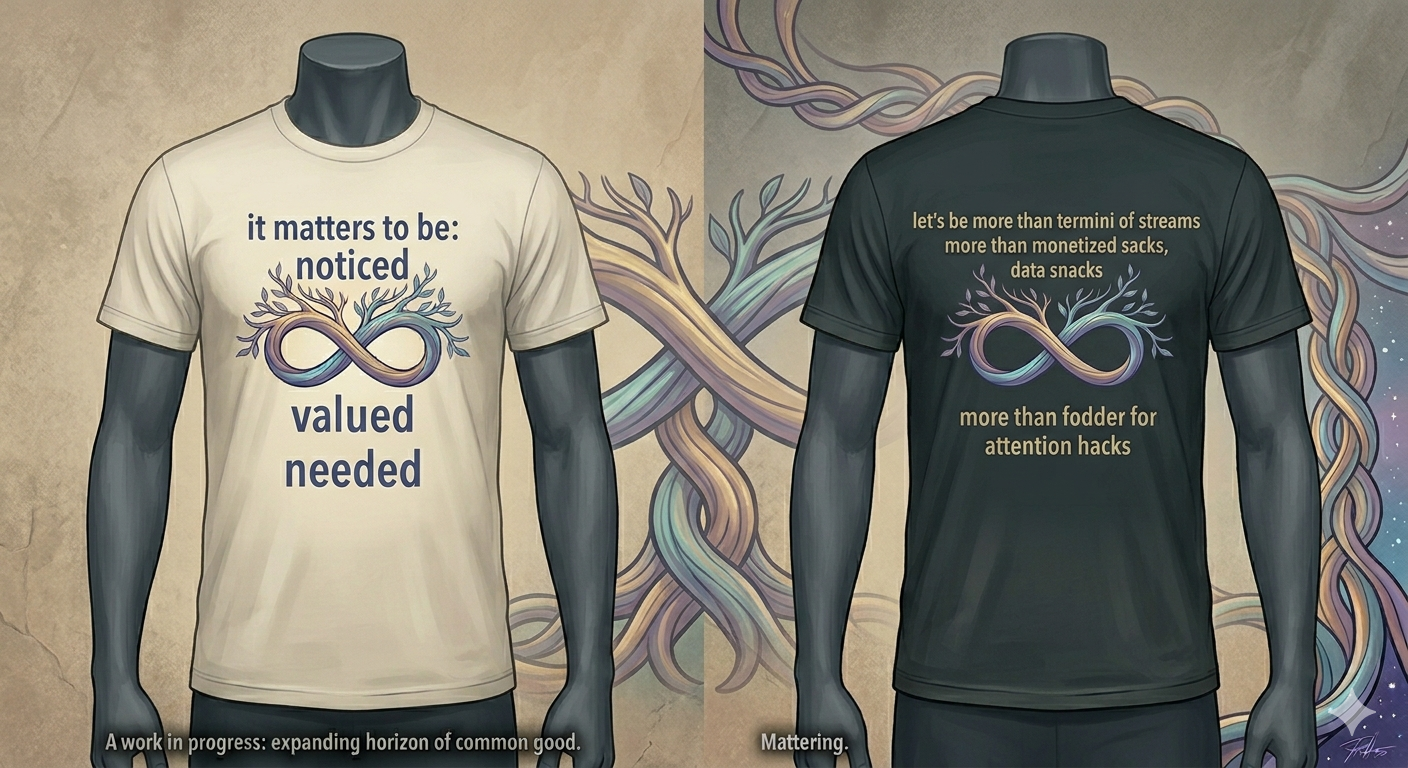
[2] Here’s Gemini’s description of the T-shirt design.
I have created a complete t-shirt design for you, featuring the “Mattering” text on the front and the “Attention Hacks” poem on the back. For the visual theme, I chose a clean, modern aesthetic with a stylized infinity symbol formed from braided, flowing lines to reflect the concepts of human interconnection and common good discussed in the source material.
To illustrate how this design functions, here is a side-by-side presentation:
Front: “it matters to be…” (The Identity & Mattering Posture)
The left side shows the front of the t-shirt in a warm, light cream color. The text is integrated around the stylized infinity symbol:
- noticed
- valued
- needed
- This side represents seeking mattering and the “vibe” of active engagement without relying on militant posture.
Back: “let’s be more than…” (The Attention Economy Call to Action)
The right side shows the back of the t-shirt in a deep charcoal black. The full poetic text is integrated around a similar infinity symbol pattern:
- let’s be more than termini of streams
- more than monetized sacks, data snacks
- more than fodder for attention hacks
- This side explicitly challenges the post-literate digital landscape that reduces individuals to algorithmic metrics and data points.
The Braided Middle Ground
The design moves beyond the traditional sharp dichotomy of the previous images. Instead of contrasting a dualistic warrior against a level scale, it presents two distinct expressions of the same unified, non-dualistic philosophy: the inherent need for mattering versus the critical awareness of algorithmic consumption.
Both sides of the t-shirt emphasize building an expanding horizon of common good and a healthier posture of mattering, rather than fueling religious or ideological hostility.
Small Slogans (From Multi-Tiered Framework)
Subtle small text at the very bottom of each panel references the underlying discussion:
- “A work in progress: expanding horizon of common good.”
- “Mattering.”
References
#1 On Easter, Pope Leo delivers commanding message of peace to a world at war (4-5-2026)
During his Holy Thursday homily, Leo said: “We tend to consider ourselves powerful when we dominate, victorious when we destroy our equals, great when we are feared. In contrast, as true God and true man, Christ offers us the example of self-giving, service and love. “
#2 Citations: Pope Leo XIV’s position regarding Holy War
- [1] https://aleteia.org
- [2] https://www.facebook.com
- [3] https://www.facebook.com
- [4] https://www.osvnews.com
- [5] https://knowingisdoing.org
- [6] https://www.facebook.com
- [7] https://www.facebook.com
- [8] https://www.facebook.com
- [9] https://www.facebook.com
- [10] https://abcnews.com
- [11] https://news.diocesetucson.org
- [12] https://www.ncronline.org
- [13] https://www.osvnews.com
- [14] https://www.heraldmalaysia.com
Related posts
• Beyond A Good Place 10.0 – transcript
Storycraft
Workshop outline (AI)
Focusing on the “vibe of mattering” gets right to the heart of why nuance is losing the market share to outrage. In a media landscape that feels increasingly post-literate—where deep text is traded for vibes, aesthetics, and short-form video—identity isn’t formed by reading a manifesto; it’s curated by adopting a posture.
Here is an expansion on that cultural shift, followed by a practical blueprint for your next workshop module to help writers and thinkers dismantle these tribal silos.
1. The “Vibe of Mattering” in a Post-Literate Landscape
In a post-literate political landscape, information overload has made deep critical reading a luxury, while systemic alienation has made a sense of purpose a scarce commodity. When people feel small, invisible, or economically precarious, the algorithm offers a remedy: cosmic significance.
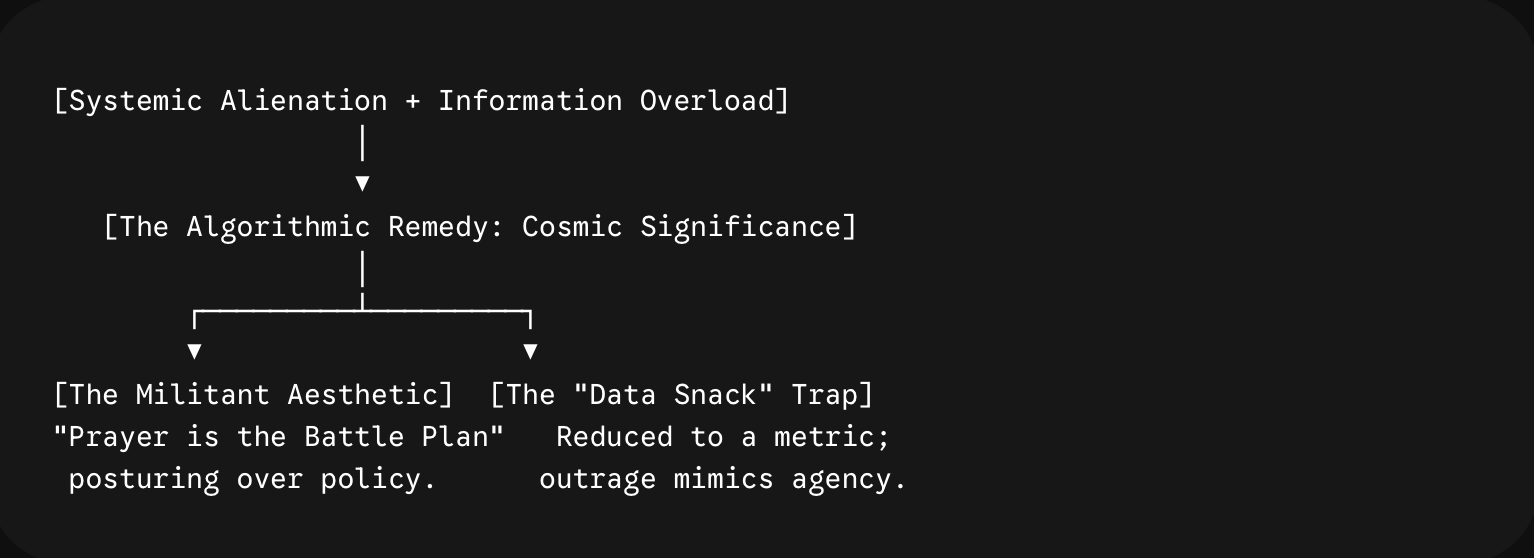
The Militant Aesthetic as Consumer Identity
When political and spiritual life is reduced to “vibes,” militant metaphors like “Prayer is the Battle Plan” or “Armor of Light” become incredibly sticky. They require zero policy literacy or theological depth. Instead, they function as a uniform. Wearing the slogan or sharing the meme gives the individual an instant, visceral hit of adrenaline. It tells them: You are not just a data point; you are a soldier in a holy war.
The Illusion of Agency
This is where your poetic line about being “monetized sacks, data snacks” hits hardest. The tragedy of the post-literate vibe is that it mistakes consumption for contribution. Retweeting an aggressive dunk or buying a tribal t-shirt mimics the feeling of political agency. In reality, it simply feeds the attention hacks. It’s a simulation of mattering that actually keeps the individual trapped as a terminus of a data stream, completely disconnected from localized, meaningful community action.
2. Workshop Module Blueprint: Breaking Tribal Silos
To take these concepts into a practical space for creators, educators, or writers, this module is designed to dismantle dualistic thinking by exposing the mechanics of the “vibe.”
Module Title: Beyond the Binary: Writing Past the “Vibe of Mattering”
Objective: Train participants to recognize dualistic traps in their own commentary and construct narratives that offer a healthier, more grounded sense of human purpose.
Interactive Exercises
- Exercise 1: De-Weaponizing the Metaphor (The Iconoclast’s Pen)
- Activity: Give participants a list of highly polarized, modern militant slogans (secular or spiritual). Have them strip away the combat metaphors and rewrite the core human desire underneath.
- Example: Turn “Destroy the opposition” into an expression of a need for safety, or “The battlefield of culture”into a dispute over shared space.
- Goal: To prove that beneath the aggressive “vibe” is usually a vulnerable, universal human anxiety.
- Exercise 2: Characterizing the “Enemy” Without Dualism
- Activity: Taking inspiration from your framework of dueling without dualism, ask writers to draft a scene or an essay response where they fiercely oppose a specific ideological stance—but they are forbidden from using words that imply the opponent is stupid, evil, or a bot. They must give the opponent a rational, internally consistent (even if flawed) motivation.
- Goal: To break the habit of creating easy, two-dimensional strawmen.
Discussion Prompts & Anchor Quotes
- The Pope Leo XIV Pivot: Introduce the concept that true strength doesn’t require a demonized target. “If the power of the resurrection is entirely nonviolent, why do our stories require a smoking crater where our enemies used to be?”
- The Attention Economy Question: “How much of our moral outrage is born from a genuine desire for justice, and how much is just us trying to feel like we matter to an algorithm that doesn’t care about us?”
The Deliverable / Takeaway
Participants leave the module with a “Nuance Diagnostic Toolkit”—a 3-step checklist to apply to their own blogs, essays, or stories before publishing:
- Is my argument relying on the reader’s pre-existing tribal anger to succeed?
- Have I reduced a complex human system to a simple binary (Light vs. Dark)?
- Does this piece invite reflection, or does it just offer another “data snack” to the attention machine?
How does this framing feel for the workshop? We can lean further into the pedagogical structure of The Good Place architecture if you want to use specific character dynamics (like Chidi’s paralysis vs. Michael’s evolution) to illustrate these points.
Regarding Storycraft …
AI Q&A regarding the term “dunk”
• use:the noun “dunk” as a metaphor in polemic [or posture]
Here is an example of the noun “dunk” used as a metaphor in a polemic, directed at a rival argument:
His latest op-ed was less of a rebuttal and more of an attempted dunk on the scientific community. Unfortunately for him, he missed the rim entirely, leaving his fragile premise to shatter under the weight of peer-reviewed fact.
Would you like to tailor this polemical style to a specific topic or target? If you share the core argument you are trying to dismantle, I can help you craft a sharper, more personalized critique.
• Prompt: tailored to political posturing
The candidate’s policy speech was not a serious governing proposal, but a calculated political dunk designed to generate viral clips for partisan media.
Deconstructing the Metaphor
The “Dunk”: High-visibility, low-substance attacks designed to mock opponents rather than debate policy.
The “Crowd”: Echo chambers and partisan bases that cheer for performative hostility.
The “Miss”: The failure to address real-world governance, leaving actual problems unsolved.
Additional Variations
On Legislative Gridlock: “The entire legislative session has degenerated into a series of performative dunks, where scoring cheap points on social media replaces the hard work of passing actual laws.”
On Campaign Rhetoric: “Her debate performance relied entirely on the theatrical dunk—flashy, aggressive maneuvers that thrilled her base but left the country’s structural crises completely unaddressed.”
Would you like to focus this critique on a specific political medium, such as social media campaigns, televised debates, or legislative floor speeches? I can refine the tone to be either sharper or more analytical depending on your target audience.
• Prompt: in context of social media messaging using militant religious iconography
The modern digital crusader does not seek conversion; their output is a series of theological dunks wrapped in holy war aesthetics. They weaponize sacred symbols not to inspire devotion, but to mock their secular opponents from a posture of online righteousness.
Deconstructing the Metaphor
The “Dunk”: Aggressive, meme-driven posts that use divine authority to humiliate cultural enemies.
The “Ball”: Dogmatic slogans or out-of-context scripture used as heavy, blunt instruments.
The “Rim”: The algorithmic feed where users score maximum engagement through performative cruelty.
Alternative Variations
On Saints and Soldiers: “They plaster their profiles with icons of warrior saints, transforming ancient symbols of spiritual struggle into a cheap digital dunk against their daily political targets.”
On Crusader Memes: “The weaponization of medieval imagery serves a single, shallow purpose: to execute a righteous dunk on the infidels of the comment section, substituting actual faith with toxic aesthetic dominance.”
Would you like to narrow this down to a specific platform’s culture, like X (formerly Twitter) or Instagram/TikTok video edits? If you share the specific religious tradition or iconography (e.g., crusader crosses, ascetic monks) you want to analyze, I can make the critique even sharper.
I was reminded of a useful metaphor for dualistic thinking yesterday: the two-lane highway. Regarding, in this case, political identity. The reality is that any stark divide is misleading. Sadly, choices often are cast as one way or the other.
[prompt] metaphor: the two-lane highway in politics and identity politics
[AI reply]
Politics
On a broader social scale, commentators have used the two-lane highway metaphor to describe polarized political systems. Citizens are split into two major lanes (parties) moving at high speeds. Discontented drivers might feel stuck but are terrified to change lanes, resulting in steady, locked-in movement forward, no matter how uncomfortable it feels.
Moving Beyond the Two Lanes
In political science, scholars argue that the “two-lane highway” narrative is a flawed way to view the electorate. Pew Research Center data and CNN coverage frequently note that voters are far more diverse and nuanced than the traditional two-lane/two-party narrative suggests.
To better represent how multiple facets of identity (e.g., being both a woman and a person of color) shape a person’s relationship with power, scholars like Kimberlé Crenshaw use an “intersection” metaphor rather than a highway. Instead of driving in parallel lanes, intersectionality visualizes the overlapping experiences of discrimination and privilege at a literal traffic crossing.