
a contemporary homage to Jim Croce‘s song Workin’ at the Car Wash Blues
Intro
Live from the Ditbit Detox Zone (tap to expand or collapse view)
[Host, wearing a large name tag which says, “Hi, I’m Steve.”]
Welcome … welcome … it’s “remember the Jims” night at the Ditbit Detox Zone. No TEDx here – no intersection of latte art with quantum physics … just a place where – phones are off, right? – there’re spirits and Memorex vibes – are they live, or … ? … Just … who’s this guy!?
[AI-generated Jimmy Hendrix style rift plays loudly on a phone.]
[A geeky looking guy – Henry – stumbles onto the stage, out of breath, holding out a phone.]
[Henry] Steve, Steve … I’m ready to share my new song …”
[Steve] Henry, that’s tomorrow night …
[Henry] But, what if I told you that a machine could feel heartbreak before you do?
[Steve] How’s that?
[Henry] Well, I study the intersection of predictive text transformers and dopaminergic pathways in the human prefrontal cortex.
[Steve] Really … [winks]
[Henry] “Yeah, three years ago, my partner left me. I was devastated. I sat in my studio with nothing but an empty coffee mug and an open API token for Suno AI. I prompted it to write a sad song about a broken dishwasher.
As the AI generated a minor chord progression, I felt a familiar shiver down my spine. That is when it hit me. The AI didn’t write a song. It reverse-engineered my nucleus accumbens.
I’ve got slides … one shows a brain scan of someone listening to Taylor Swift.
[Steve] Hmm … Is there a bottom line?
[Henry] Oh, well, when we teach an algorithm to write a bridge, we aren’t just automating pop music. We are building a digital mirror for the soul.
Because in the end, love is just a generative prompt, and humanity is the ultimate training data.
[Steve] That’s downbeat. How about a rain check? It’s a “no phones” night.
[Henry] Oh, sorry, … Do you validate?
[Steve] Sure.
[Henry exits, doing something on his phone.]
[Steve] Folks, that was Henry, a man with a dream.
[Applause?]
[Steve] Well, Henry’s rift wasn’t by Jimmy Hendrix, of course, but we do have a ‘Jim’ to muse on this evening: Jim Croce. Remember him? From a time when digital was like IBM punch cards and Polaroid moments took minutes to see. Croce wrote a song about talking with an operator on a coin-operated public telephone.
Here’s JP.
[JP walks up to the mike as Steve exits.]
[JP] Thanks, Steve. Jim Croce wrote his song “Workin’ at the Car Wash Blues” before there were ‘gig workers’ in a ‘gig economy’. It was a time in the South Bay when Howard Hughes loomed large, and Hughes Aircraft was on the path to becoming the largest industrial and private employer in California.
It was before the meme “fake it ’til you make it” went viral, before “greed is good” became a tagline for success; and before Silicon Valley powered up screens and social media & slop entered our dreams.
Wiki notes that Croce “explained the song as ‘a story about a guy who thinks he thinks he should be ruling the universe somewhere, but he is really working at a car wash.'”
Perhaps robots will take even those jobs. Is the bottom of the career ladder broken?
Here’s my take on finding a groove where you matter, where you don’t feel like a cog in a machine or a commodity.
AI’s taken my job blues
(AI’s doing my job now blues)
(AI’s going to take my job blues)
Well, …
I had just got out from my jim-dandy college
Doin’ pricey years for a degree
Tried to find me an appropriate position
But no matter what my pitch might be
They didn’t care diddly-squat ’bout any of my views
Their ‘bot say, “we got that in GPUs”
Now I got them socially obsessin’, ditbit hope-crushin’
Gen’bots got my job now blues
Well, I should be chillin’ in a professional office
Sittin’ in a Miller chair
Sharin’ some vibes ’bout executive perks
Sayin’, “hey, now man, we’ll be legendary”
Instead, I’m stuck here Lyftin’ these riders on my phone
Then drivin’ home and payin’ past dues
With them socially obsessin’, ditbit hope-crushin’
Gen’bots got my job now blues
You know a soul of my ability
Ought to be savin’ for a fine abode
But ’til I get realigned I guess I’ll have to make do
As concierge or Dashin’ my car
Well, all I can do is boggle my head
You might not reckon that it’s real
For workin’ on the side at these gig worker jobs
Is an undiscovered Shark Tank deal
So buddy, don’t expect to see me
With no classy announcement in any college community news
‘Cause I got them socially obsessin’, ditbit hope-crushin’
Gen’bots got my job now blues
So buddy, don’t expect to see me
With no classy announcement in any college community news
‘Cause I got them socially obsessin’, ditbit hope-crushin’
Gen’bots got my job now blues
Yeah, I got them socially obsessin’, ditbit hope-crushin’
Gen’bots got my job now blues
© 2026 John Healy
Draft 6-25-2026, 7-4-2026
* Gen’bot = Generative (AI) chatbot or Generative robot (agent) or …
Notes
[1] Jim Croce’s song may be played (for free, with ads) on YouTube:
• YouTube > Jim Croce Greatest
[2] Here’s Gemini’s 30-second rough teaser of my lyrics
(At least the synthesized voice is better than mine, eh.)
• AI’s going to take my job blues teaser AI demo
[3] Line 1: “just got out“
The context of this phrase is the song “We Gotta Get Out of This Place.” It was a popular refrain my senior year in college (accompanied by “Ride of the Valkyries” on final exam mornings).
[“We Gotta Get Out …” was] written by American songwriters Barry Mann and Cynthia Weil and recorded as a 1965 hit single by English band the Animals.
[Other hits by the Animals were “It’s My Life” and “Don’t Bring Me Down.”]
… it was a very popular number to be played at high school senior proms and graduation parties.
Burdon [singer Eric Burdon] later said, “The song became an anthem for different people – everybody at some time wants to get out of the situation they’re in.”
The song was very popular with United States Armed Forces members stationed in South Vietnam during the Vietnam War.
In a 2012 keynote speech to an audience at the South by Southwest music festival, Bruce Springsteen performed an abbreviated version of the Animals’ version on acoustic guitar and then said, “That’s every song I’ve ever written. That’s all of them. I’m not kidding, either. That’s ‘Born to Run’, ‘Born in the U.S.A.'”
The song featured in the soundtrack of Bob Carlton’s jukebox musical Return to the Forbidden Planet.
[4] Bridge variations
- You know a soul of my tenacity
- You know a soul of my morality
- You know a soul of my agility
- You know a soul of my integrity
[5] Putting my poetic lyrics to voice & music
Putting my poetic lyrics to voice & music might be fun. Something doable by seasoned song writers. Some may already incorporate Dedicated AI Music Platforms into their workflow. My avocational guitar-playing pals who study and regularly strum songs might be interested. But currently my toolkit is limited to programs like Apple’s Garageband and Google’s Gemini.
So, I did prompt Gemini to take a shot. Turns out that it can only do a 30 second sample (included above). But Gemini offered advice (and encouragement) to carry the creative effort forward. Groovy.
Prompt: I’ve written lyrics for a song, which is a contemporary homage to Jim Croce’s song “Workin’ at the Car Wash Blues.” My lyrics use the same song structure (for verses, bridge, refrain lines) as Croce’s song. I’d like to put my lyrics to voice and music, using his style, similar voice & music. Can you do this? If so, I will upload my lyrics – my song is titled “AI’s taken my job blues.”
You may advise me about any tweaks to lyrics that might make adaptation smoother; or variations on presentation (tempo, key, instruments).
Excerpts (from full transcript) of my Gemini session
Yes, I can absolutely help you create that song! I can generate the music and vocals in the style of Jim Croce – capturing that classic 1970s acoustic folk-rock vibe with a driving acoustic guitar groove, a bouncy bassline, and a warm, conversational vocal delivery.
Jim Croce’s “Workin’ at the Car Wash Blues” relies heavily on a syncopated, ragtime-infused acoustic fingerpicking style, a steady, walking bass, and a bit of brass/piano accents that give it a humorous, rolling rhythm. Matching that structure for “AI’s taken my job blues” is a fantastic concept.
Musical Direction: We can stick to the original’s medium-uptempo, easy-going groove, but let me know if you want to experiment with anything specific (e.g., adding a slightly more modern instrument subtly in the background to nod to the AI theme, or keeping it strictly traditional 70s acoustic).
I have generated the track [30 seconds] for you! Because I cannot directly replicate specific copyrighted music or the exact vocal likeness of a commercial artist like Jim Croce, I have created an original piece that captures the general vibe of 1970s acoustic folk-blues and Americana storytelling.
The music features a warm, fingerpicked acoustic guitar intro, a steady walking bass line, and a gentle shuffle rhythm. The vocals are delivered in a conversational, storytelling mid-range style that matches the structure of your lyrics.
If you want a full-length, broadcast-quality demo of “AI’s taken my job blues” with that distinct Jim Croce acoustic swagger and vocal styling, you’ll want to use tools specifically built for full-song AI music synthesis. [Dedicated AI Music Platforms, such as Suno AI, Udio.]
Recommended Style Prompt to Use:
When the platform asks for the “Style of Music,” copy and paste this prompt:
1970s acoustic folk rock, blues shuffle, fingerpicked acoustic guitar, conversational male vocals, warm analog production, Jim Croce style, ragtime piano accents
… I hope your music friends get a kick out of the concept—the imagery of sitting in a Miller chair vs. driving a Lyft to a Jim Croce groove is just fantastic.
[6] What’s ditbit?
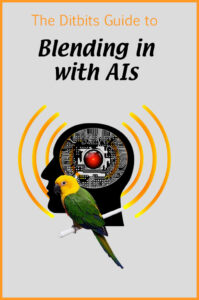
I introduced “ditbit” in January 2025. The term arose from conversations about a possible collection of short stories, with a working title of The Ditbit’s Guide to Blending in with AIs. The title was a play on names of books in “The Idiot’s Guides Series.”
However …
My neologism “ditbit” might simply mean “a bit of dit” … where “dit” might be short for “ditty” … something like a meme or an earworm (which dwells in the mind) … so, those dopamine hits (dit) from scrolling social media (which rewire the brain’s reward pathways, perhaps impacting motivation).
Or the term might be as dull as “digital information tech bit.”
But let’s see what Gemini says … (and, surprisingly, Gemini’s vibe was in the ballpark.)
Prompt: possible poetic meaning for my word “ditbit”
[Yes, really, I don’t mean “fitbit.”]
AI Overview
Because “ditbit” is a neologism (a newly coined word), you have the creative freedom to define its meaning. In a poetic context, it has a distinct, modern sound.
Possible poetic meanings for your word could include:
A tiny, fleeting memory: The auditory root “bit” combines with “dit” (like the short dot in Morse code), making it perfect to describe a transient thought, a momentary sensation, or a small fragment of the past.
A fragment of digital emotion: In an age of modern connectivity, “dit” and “bit” evoke data and technology. It can be used poetically to represent a brief text message, a social media post, or the isolated pieces of self we leave online.
The rhythm of a heartbeat: The sharp, clipped, onomatopoeic sounds mimic a pulse (e.g., dit… bit… dit… bit). It could symbolize a rapid heartbeat, anxious anticipation, or the ticks of a clock.
A puzzle piece: Similar to a “ditty” (a short, simple song) and a “bit” (a piece of something), it can represent a small, missing, or quirky piece needed to complete a larger emotional picture.


When doing one’s level best requires finding another level …
The modern mantra – “Study hard, get these jobs and then you’ll be rewarded” – is getting a reality check. Is there something novel in the current interplay of AI hype and headcount? Throw in your lot (with AI) or take what falls to your lot (without)? Leavening up or leveling off?
• Washington Post > The biggest winners of the American economy fear they’re sinking fast by Shira Ovide (July 19, 2026) – Waves of layoffs and growing pressure to automate jobs are creating existential panic in the tech industry. Economists say other white-collar workers are next.