
[Draft 4-14-2026, 5-1-2026]
Homages
“I don’t know whether anyone will care to examine my heart, but if they do, they will find two words there – ‘social justice.'” – Upton Sinclair
“It is difficult to get a man to understand something, when his salary depends upon his not understanding it.” – Upton Sinclair
“It is foolish to be convinced without evidence, but it is equally foolish to refuse to be convinced by real evidence.” – Upton Sinclair
Weighing of the Heart ceremony
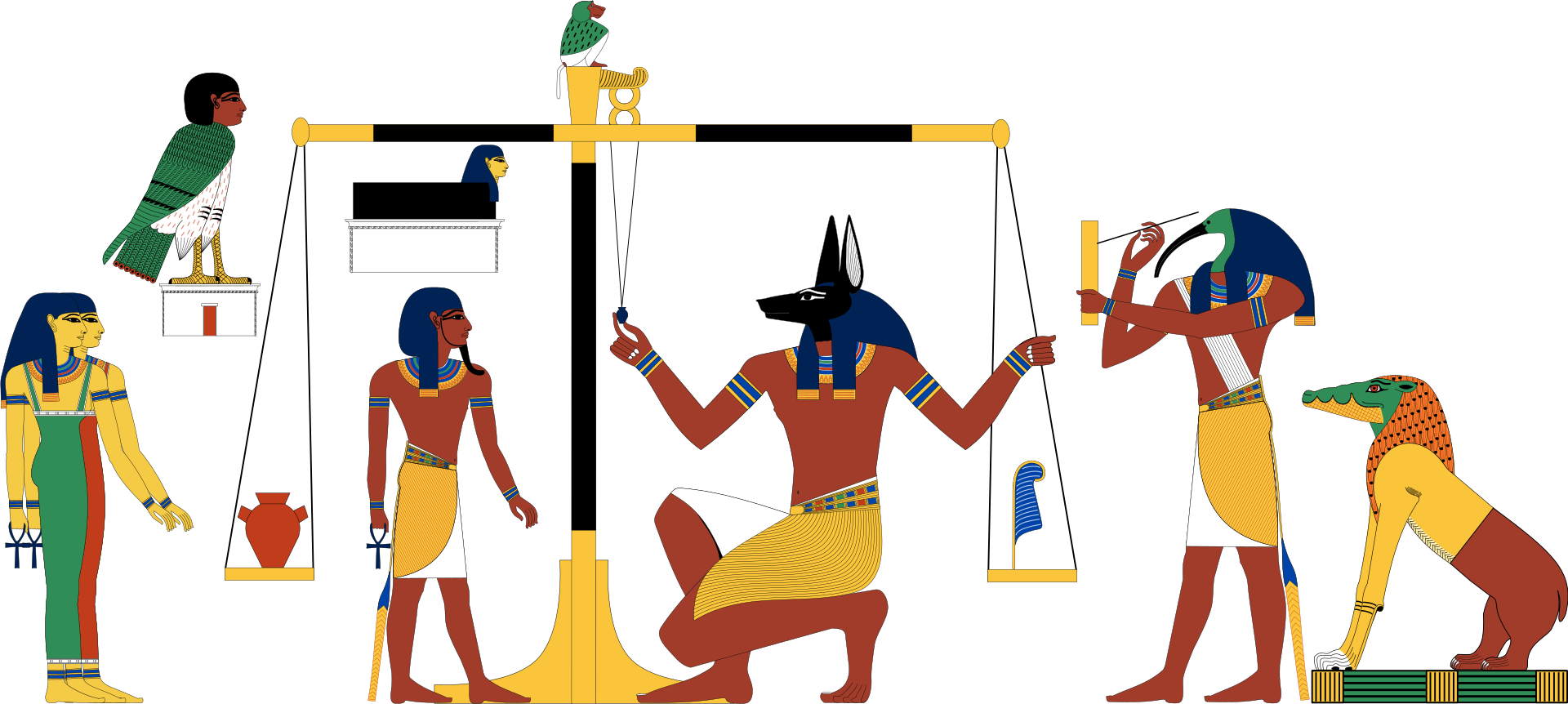
The tallies of Maat’s scribes showed drift. There had been anomalies in the ceremony before. But this was no longer rare in the endless line waiting assessment. Thoth mentioned this to Osiris.
[dialog]
THOTH: These departed wait without complaint, move along as usual in the Hall. But they’re silent when asked the 42 Questions. Blank, without any resistance or hesitation. Sometimes just a smile or … an odd comment, like: “Let’s dance!” “Where’s my room?”
My Lord, there’s no longer any sense of self – no agency. They pass the weighing. But is it proper to pass them on?
The uncertainty is unsettling.
OSIRIS: Perhaps this is mischief. My brother’s doing. To cast doubt on my reign, that our great order is no longer balanced.
A family dispute should not pollute the path forward. These souls deserve another chance, rather than oblivion. They will be marked, so as to be identifiable on return to the Hall. Make this so, and look further into the situation … secretly.
But the drift only became worse. Something in the nature of things had gone awry on a particular world. Earth. Maat’s chief statistician said it was a perturbation in cosmic harmony.
And that required more information. An investigation into the mortal world.
The old gods had faded from the press, resigned themselves to irrelevance, at least on some worlds like Earth. But the gods remained vital. Besides, there was an idle workforce. Their offspring, lesser deities, were eager for laurels.
- Osiris establishes a front on Earth, the ODA. Jimmy Maat is one of the first to volunteer. LA is a good place to start.
- Jimmy has a rough time adjusting to the new, mortal landscape. (He’d been living in the basement of his parents’ place.) Like a Pinocchio character, he makes mistakes. There’s friction between his new desires and his mission. It wears on him. There’s a price – TANSTAAFL. [1]
- While Jimmy has agency, he needs help. How does one workshop such a task? What’s the cover story? Who does he recruit? The desparate, … the nostalgic … those ready to risk regaining themselves. Just for money? For something ethereal, not realized in a lifetime? How does he manage his associates, confidential informants? Why, of course, by T&C, eh. That’s the modern way. No need to sign in blood.
Jimmy’s dilemma

What is Jimmy’s perspective on the problem? How does he get a handle on such a massive undertaking – like all those starfish stranded on a beach [2] … do individual good deeds or become a catalyst? which stranded souls to help? is there any common cause or just too many related causes? is there really any systemic solution? even if so, where’s the leadership – mortal or otherwise? is this a case for “invisible” (behind the scenes) celestial leverage? [3]

LA’s Skid Row reminds Jimmy of scenes of poverty, loss, and dislocation from ages ago. It’s a thread – a lifeline – which matters, intertwined with others which might provide leverage in understanding the drift in dispossessed, displaced, disappeared souls.
He’s encountered galas which patronize indigents, glad that “someone” is doing something. Photo-ops, not connecting the dots. Posturing without real protection for the complex, informal & fragile ecosystem of care doing that “something” – dealing with the daily consequences.
This is the landscape of the classic film Soylent Green (1973), with evidence of crisis – tents & tarps – swept off the streets. And people disappearing, “going home” to die, for release from suffering.
• LA Times > “Mayoral candidates ignore the real Skid Row” by Vijay Gupta, Guest Contributor (5-19-2026) – Homelessness is collective apathy made flesh. The poorest are left to carry the weight of a failure that belongs to all of us.
For the last 17 years, I have made music between Disney Hall and Skid Row — performing Beethoven for billionaires on Grand Avenue, and playing for those living on San Julian Street — surviving the worst days, months and years of their lives.
When candidates in the L.A. mayoral race mention “Skid Row,” they’re referring to the visible crisis. They have plans for that Skid Row — sweeps, shelter beds, Inside Safe, encampment clearances. We’ve seen similar plans from previous mayors fail again and again — public spending on homelessness in L.A. has surged into the hundreds of millions of dollars annually over the last decade, while more than 75,000 people across L.A. County still remain unhoused.
What almost nobody running for the mayor’s office says is that Skid Row is not simply one of America’s largest homeless communities, and a crisis that needs to be solved. It is also one of America’s largest informal systems of rehabilitation, recovery, psychiatric triage, reentry and mutual survival that needs to be sustained.
… clinics and shelters … all staffed largely by people recovering from their own years on Skid Row.
And then there is the Skid Row nobody campaigns on: the one that keeps people from ending up on the street, and the one that keeps people from returning to the street once they’ve left.
We criminalize and displace the people whose suffering makes us uncomfortable, because their fragility mirrors our own, and that is easier to clear than to confront.
Vijay Gupta , a violinist, is a recipient of the MacArthur Fellowship, the founder of Street Symphony and the author of “Restrung, A Memoir of Music and Transformation.”
Notes
[1] TANSTAAFL – There ain’t no such thing as a free lunch

The commentary for Robert A. Heinlein’s 1966 novel The Moon Is a Harsh Mistress highlights the theme of TANSTAAFL in his writing.
The novel explores libertarian ideals, focusing on the concepts of individual liberty, voluntary association, and free-market economics. The book also popularized the term TANSTAAFL (“There Ain’t No Such Thing As a Free Lunch”), which in the story underscores the Moon’s harsh reality that every resource and every freedom carries a cost.
The Oxford Dictionary of Quotations credits this novel with the first printed appearance of the phrase “There’s no such thing as a free lunch.” However, there are many earlier examples of the phrase in written English going as far back as the turn of the 20th century.
Algis Budrys of Galaxy Science Fiction in 1966 praised The Moon Is a Harsh Mistress, citing “Heinlein’s expertise for dirt-level politics, snappy dialogue and a sense of an actual living society.”
He said that he had never read a more believable computer character than Mike (“may in fact be the most fully realized individual in the story”).
Budrys suggested that the story may actually be Mike manipulating humans without their knowledge to improve its situation, which would explain why the computer no longer communicates with them after the revolution succeeds. Reiterating that Mike manipulated the humans, in 1968 Budrys said that every review of the book, including his own, erred by not stating that the computer is the protagonist.
Carl Sagan wrote that the novel had “useful suggestions for making a revolution in an oppressive computerized society.” SF Reviews published a review after 9-11, arguing that “during this current War On Terror, it might be worth reading this novel just to gain a clearer idea of the difference between terrorists and freedom-fighters, and under which conditions it might be better to lie, use and abuse individuals in order to give them what you believe is a better world.”
Leigh Kimmel of The Billion Light-Year Bookshelf said … “the computer which suddenly wakes up to full artificial intelligence, but rather than becoming a Monster that threatens human society and must be destroyed as the primary Quest of the story, instead befriends the protagonist and seeks to become ever more human, a sort of digital Pinocchio.“
Perhaps, in my story, Maat likewise decides to manipulate humans to improve their souls?
And Heinlein s “Dinkum Thinkum” remains appropriate to our 21st century AI landscape.
• AI Overview
“That Dinkum Thinkum” is a phrase from Robert A. Heinlein’s 1966 science fiction novel, The Moon Is a Harsh Mistress. It is used by the protagonist, Manuel Garcia O’Kelly, to refer to the sentient supercomputer, Mike, who becomes a central figure in a lunar revolution.
Here is a breakdown of the term:
- Context: It appears as the title of Part One of the novel and describes the emergent, conscious-like state of the computer.
- Dinkum: Derived from Australian slang, “dinkum” (or “fair dinkum”) means genuine, authentic, honest, or real.
- Thinkum: A colloquial, invented term for a “thinking machine” or computer.
- Meaning: Together, “that dinkum thinkum” means “that genuine/authentic thinking machine,” highlighting the computer’s intelligence and, eventually, its self-awareness.
The phrase is part of the “Loonie” (lunar resident) slang developed by Heinlein for the book, which blends Australian slang, Russian, and tech jargon.
[2] AI Overview – The Starfish Story (parable)

The Starfish Story (or “The Star Thrower“) tells of a person throwing stranded starfish back into the ocean, one by one. When told they cannot save them all or make a difference, they throw another and reply, “It made a difference to that one”. It is a parable about how individual actions matter and create a ripple effect, even if they cannot solve a massive problem entirely.
Key Aspects of the Parable:
The Scene: Miles of beach are covered in thousands of dying starfish, washed up by a storm and shrinking tide.
The Disillusionment: A spectator argues that the efforts are futile, as the child/person cannot possibly save every creature.
The Lesson: The hero highlights that even small, individual actions have significance.
The Result: The spectator is inspired, and in many versions, joins in, demonstrating how one person’s commitment can influence others.
This story is frequently used to encourage philanthropy and volunteerism, emphasizing that one should never overlook the value of helping one person, even if you can’t help everyone. Some interpretations note the story as a balance between immediate aid and the need for addressing larger systemic issues, as detailed in this analysis of The Starfish and the System.
References
• Wiki > The Star Thrower – a story which has been adapted many times, with many variations
“The Star Thrower” (or “starfish story”) is part of a 26-page essay of the same name by Loren Eiseley (1907–1977), published in 1969 in The Unexpected Universe. The Star Thrower is also the title of a 1978 anthology of Eiseley’s works (including the essay), which he completed shortly before his death.
• Amazon > Star Thrower
“The book will be read and cherished in the year 2001. It will go to the MOON and MARS with future generations. Loren Eiseley’s work changed my life.” – Ray Bradbury
• deming.org > The Starfish and the System by Doug Stilwell, Assistant Professor of Educational Leadership and Director of Drake Continual Improvement Network, Drake University (11-30-2022)
There are many variations of the original story, one of which goes like this:
One day a man was walking along the beach when he noticed boy picking up and gently throwing things into the ocean.
Approaching the boy he asked, “Young man, what are you doing?”
“Throwing starfish back into the ocean. The surf is up, and the tide is going out. If I don’t throw them back, they’ll die,” the boy replied.
The man laughed to himself and said, “Do you realize there are miles of miles of beach and hundreds of starfish? You can’t make any difference.”
After listening politely, the boy bent down to pick up another starfish and threw it into the surf. Then, he smiled at the man and said, “I made a difference to that one.”
In addition to the important lesson for leaders to understand systems and how to lead them, there is another moral to this revised starfish story. It is a quote borrowed from the Chinese philosopher Lao Tzu and modified slightly to address the context of this writing, and is an important one for leaders to consider:
“A systems leader is best when people barely know he exists; and when his work is done, his aim fulfilled, they will say: we did it ourselves.“

[3] Perhaps Jimmy’s bummed out about hospice fraud as well?
• LA Times > California was warned of shocking hospice fraud. Inaction allowed scams to continue by Hannah Fry and Richard Winton (4-17-2026 updated for 3-29-2022)
[4] AI audio teaser and transcript for this page
Recently, I stumbled across a new feature in the Android Chrome browser: Listen to this page. There are two modes: just read the page’s text (accessibility), and create a podcast-like teaser of the contents. The audio teaser was fascinating. It boiled down my entire “featherweight soul – exposition” page to a one and a half minute promo.
Here’s that audio file and its transcript.
Have you ever wondered what happens if the scales of justice just stop working for the souls of the dead?
Well, in this piece by the author, JPH, that’s exactly the crisis Osiris and Maat are facing. They’re seeing these souls arrive at the Hall of Judgment, who are just totally blank, no agency, no sense of self at all.
Wait, so they aren’t even resisting the 42 questions? They’re just silent or saying things like, let’s dance.
Exactly. Osiris suspects his brother is causing mischief to make it look like the cosmic balance is failing. So he sends a lesser deity, Jimmy Maat, down to earth as a secret investigator for the ODA.
Okay, so a god living in Los Angeles, that sounds like a rough transition, especially if he was living in his parents’ basement before.
It’s a struggle for him. He’s trying to figure out if he should help people one by one, like that story about throwing starfish back into the ocean or if there’s some systemic problem on Earth causing this soul drift.
Right, and the author brings in Robert Heinlein’s idea of TANSTAAFL. There is no such thing as a free lunch, right?
Right. Every freedom has a cost. Jimmy even considers using things like modern terms and conditions to manage his informants, which is such a contemporary twist on making a deal with a god.
It’s a clever way to look at whether we’re losing our agency in the modern world.